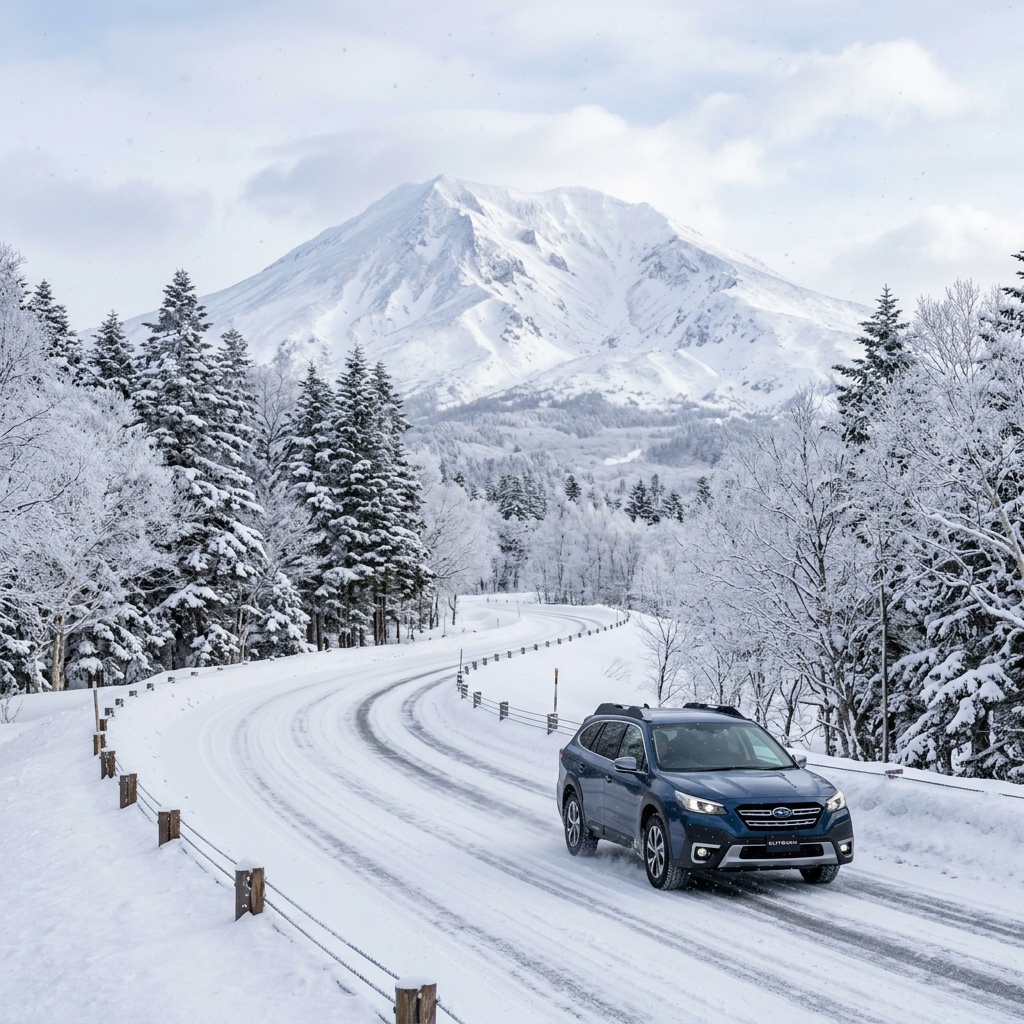
Why Japow and a Rental Car Belong Together
Japan's ski resorts owe their reputation to a meteorological quirk: frigid Siberian air picks up moisture over the Sea of Japan and dumps it as exceptionally dry, light powder over Hokkaido and the Japanese Alps. Skiers around the world speak of the result in reverent tones — "Japow", Japan powder.
The full process — what the document is, who issues it, and how to order one before you fly — is covered in our JAF translation guide.
You can absolutely get there by train and transfer bus. But anyone who has sprinted through a Japanese railway station with two ski bags, a boot bag, and a suitcase understands why so many winter travelers switch to a rental car:
- Luggage logistics. Skis, boards, boots, and winter layers go in the trunk instead of a Shinkansen overhead rack. Load up, drive off, done.
- Powder flexibility. The best snow doesn't always fall where your hotel is. With a car you chase the storm — between Niseko and Rusutsu in Hokkaido, or between the spread-out base areas of the Hakuba Valley.
- Beyond the shuttle routes. Onsen villages, late-night ramen shops, and supermarkets for the self-catered lodge often sit outside the ski-bus corridors.
- Families and groups. With kids and a mountain of gear, your own vehicle is simply less stressful — and split between several people, often cheaper than individual transfers.
In fairness, the other side too: if you're spending two weeks in a single resort village — say, right at the gondola in Hirafu — and shuttles cover every errand, you don't strictly need a car. For everyone else, the rental car is the key to the Japanese winter. Not sure whether you're even allowed behind the wheel? Start with our country-by-country check: Can I Drive in Japan?
The Paperwork: Your License Decides Everything
Here's the single biggest trap in planning a Japan ski road trip — and the part most blogs get wrong. What documents you need depends entirely on the country that issued your driver's license, not your nationality:
- US, UK, Australia, Canada, Austria, and other 1949 Geneva Convention countries: you're in the easy group. Japan recognizes the 1949-format International Driving Permit (IDP). Get one from your home country's authorized IDP issuer (AAA in the US, your state motoring club in Australia) before you fly — Japan doesn't issue them to visitors — and carry it together with your home license. The Netherlands, Italy, Spain, and New Zealand are in this group too.
- Switzerland, Germany, France, Belgium, Monaco, and Taiwan: an IDP will not help you. Japan only accepts IDPs issued under the 1949 Geneva format. Switzerland, Germany, and Taiwan never ratified that convention. France, Belgium, and Monaco did ratify it, but now issue their international permits under the newer 1968 Vienna Convention format instead — which Japan does not recognize. Instead, Japanese law requires an official Japanese translation of your license under Article 107-2 of the Road Traffic Act, carried together with your original license. Without that translation, no rental counter in Sapporo or Nagano will hand over the keys — no matter how confirmed your booking is.
This distinction matters enormously for mixed groups: an American and a Swiss friend planning the same Niseko trip need two completely different documents. The translation, once issued, lets its holder drive for up to 1 year from the date of entry into Japan — far more than enough for a ski holiday, and still valid if they return for a summer road trip.
For the ski season, the practical takeaway is simple: if you're booking flights and lodging for January in the autumn, sort the driving documents in the same sitting. IDP holders can visit their automobile association any time; translation-country drivers should order early enough that the cheapest plan comfortably makes the deadline.
Swiss or German license? Sort the translation today.
Photograph your license, apply online in English, and get the PDF to book your car with before you fly — from €99 / CHF 99.
Start Your Application →Winter Driving in Japan: Left-Hand Traffic Meets Snow
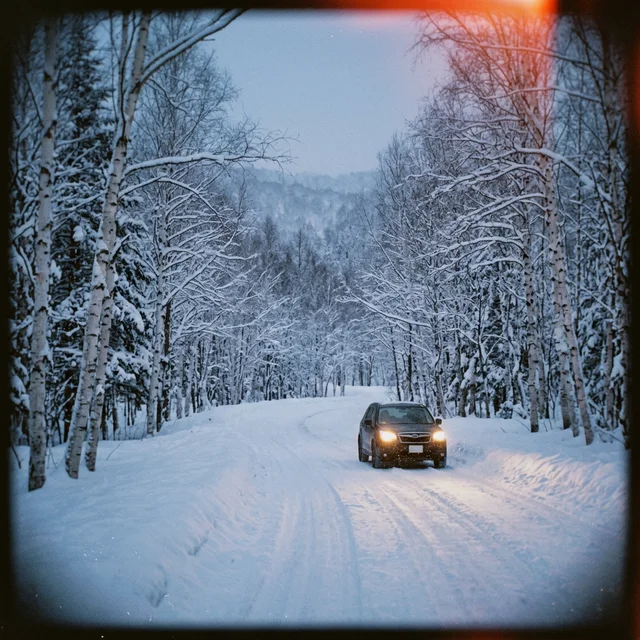
Two things come together on a Japanese winter road trip that you may know separately: driving on the left and driving on snow. The combination is very manageable, but it deserves respect and a few adjustments:
- Studless winter tires are the norm in snow country — but always confirm. Major rental companies in Hokkaido and Nagano typically fit winter tires (called studless tires in Japan, since studded tires are largely out of use) as standard equipment in the winter months. Don't rely on that blindly: confirm explicitly at booking that winter tires are included, especially if you're collecting the car in a low-snow city and heading into the mountains.
- Book 4WD. For resort access roads we recommend an all-wheel-drive vehicle. On the snowed-in grade up to your lodge, the difference isn't comfort — it's safety.
- Smooth is the new fast. Japanese winter roads are plowed regularly but are often snow-packed or polished slick, with black ice a real risk in the early morning and evening. Brake early and gently, double your following distance, and keep your speed well under the limit — that's how the locals drive.
- Actively "think left." The critical moments aren't on the expressway — they're turning at an empty intersection or pulling out of a parking lot. A sticky note on the steering wheel ("LEFT!") sounds silly and works brilliantly. More adjustment tips in our Japan driving tips guide.
- Develop weather sense. In heavy snowfall, mountain passes and individual road sections can close temporarily, and visibility can drop to a few meters within minutes. Build in generous time buffers, don't drive into the mountains at night straight off a long-haul flight, and keep an eye on conditions via the car's navigation system.
- Fuel and tolls. Gas stations thin out in the mountains — fill up before the gauge insists. On the expressway, the rental company's ETC card is worth taking; it spares you fumbling with cash at toll gates.
Winter tyres, chains and rental cars: the rules (checked 21 October 2026)
In short: Japan has no single national winter-tyre law, but Hokkaido and Nagano both require winter tyres or chains on snowy or icy roads, and the large rental companies fit studless tyres as standard there during set periods.
- On snowy roads. Hokkaido's traffic rules require snow tyres on all wheels, or chains, when the road is snowy or icy; Nagano's require chains or winter tyres. In Nagano the traffic fine (反則金) for an ordinary car is ¥6,000 (Hokkaido Police, Nagano Prefecture).
- Two kinds of restriction. Under a winter-tyre regulation (冬用タイヤ規制), winter tyres or chains are enough. Under a chain regulation (チェーン規制), you need chains even with studless tyres or 4WD, and spray-on products do not count. MLIT lists 13 sections (seven on expressways, six on national roads) where chain regulation can be imposed during exceptional snowfall; none of them is in Hokkaido (MLIT, NEXCO Central).
- Chains. Nippon Rent-A-Car and Times Car Rental do not rent chains; Toyota offers them, but not every shop has them (Nippon Rent-A-Car, Times, Toyota). Ask when you book if your route could come under a chain regulation.
- Short days. On 15 December 2026 the sun sets at 16:00 in Sapporo (National Astronomical Observatory of Japan). Plan mountain stretches for daylight.
- If something goes wrong. JAF road service answers 24 hours a day on #8139 or 0570-00-8139 and offers free phone interpretation in 24 languages, including English, French and German (JAF). Road closures: MLIT's road information system (with an English view).
- Your licence rule is the same in winter. Swiss, German, French, Belgian and Monegasque licences still need the official Japanese translation together with the original licence (National Police Agency).
| Rental company | Studless tyres standard: Hokkaido | Studless tyres standard: Nagano | Winter charge |
|---|---|---|---|
| Toyota Rent a Car | 1 Nov – 5 May (Obihiro from 31 Oct) | 1 Dec – 31 Mar | season rate applies |
| Nippon Rent-A-Car | 1 Nov – 20 Apr (4WD standard) | 1 Dec – 31 Mar | ¥660 a day in Hokkaido, ¥330 in Nagano, charged for 10 days at most |
| Times Car Rental | 1 Nov 2026 – 15 Apr 2027 | 1 Dec 2026 – 31 Mar 2027 | ¥660 per 24 hours, up to ¥6,600 |
From each company's own pages, checked on 21 October 2026. Outside these periods studless tyres are an extra from about ¥2,200 a day, so a trip to Nagano in November needs them booked explicitly.
The Resorts: Getting There by Car
All drive times below are deliberately approximate: in the Japanese winter, snowfall, plows, and traffic set the pace — after fresh snow, the same stretch can take considerably longer. Always plan with a buffer.
- Niseko (Hokkaido): the international star of Japanese skiing, famous for enormous snowfall and the four linked sectors of Niseko United. Pick up your rental car at New Chitose Airport (Sapporo); from there it's roughly 2–3 hours depending on route, weather, and traffic. With your own car, nearby Rusutsu slots in effortlessly as a stop en route or a day trip — one of the strongest arguments for driving.
- Hakuba Valley (Nagano): host of the 1998 Winter Olympics and home to around ten ski areas spread along the valley — exactly where a car earns its keep, because the base stations sit kilometers apart. From the Nagano IC expressway exit, allow about 1 hour into the valley (conditions permitting). Coming from Tokyo, the region is several hours away via the expressway network.
- Worth the detour: in Hokkaido, Furano tempts with dry inland snow; on Honshu, Nozawa Onsen pairs skiing with a historic hot-spring village, and Myoko Kogen delivers deep snow with fewer crowds. All are reachable on Japan's well-built expressway network — and it's precisely this "second row" of resorts that's far more tedious to explore without your own vehicle.
One practical note on pickup: your documents — the 1949 IDP, or for translation-country drivers the official translation — are checked right at the counter, together with your original license and passport. If one piece is missing, the keys stay with the rental company.
What It Costs: Documents in Detail, Rentals in Honest Terms
Rental car pricing depends on season, vehicle class (4WD costs more), rental length, and one-way fees — exact figures shift by company and booking date, so we'll spare you invented numbers. The most important cost rule is simple anyway: book early. Around New Year and Lunar New Year, 4WD vehicles in Hokkaido regularly sell out.
The mandatory document, by contrast, can be priced precisely. Here's the honest market overview for the official translation (Swiss, German, French, Belgian, Monegasque, and Taiwanese licenses):
| Provider | Price | Turnaround & notes |
|---|---|---|
| JDLTC Standard | €99 / CHF 99 / NT$3,290 | 3–4 weeks; application & support in English, PDF by email before departure to book your car; JAF's paper original, which you drive with, delivered to your hotel or rental counter in Japan for +€10 / CHF 10 / NT$350 (all plans) |
| JDLTC Express | €139 | 5–7 days |
| JDLTC Rush | €179 | Typically 1–3 business days* |
| JAF (Japan's automobile federation) | ¥6,000 (tax-exempt) | Online application only, from networks inside Japan, in Japanese; you print the translation at a convenience store in Japan |
📦 Some rental companies cannot accept parcels, so please choose your hotel for delivery whenever possible.
* Rush turnaround is an estimate, not a guarantee; it depends on application volume.
To say it plainly: on price alone, applying directly to JAF is cheaper. If you read Japanese and will be in Japan a few days before you pick up the car, it's a solid choice. JDLTC is built for the opposite case — you handle everything in English, before departure. The PDF for your rental booking sits in your inbox before the suitcase is packed, and JAF's paper original, which you drive with, is delivered to your hotel or rental counter in Japan (+€10 / CHF 10 / NT$350). On a ski trip where flights, lodging, and lift passes are long since paid for, the predictable document is the cheapest insurance of the whole holiday. If departure is suddenly days away, our Rush service guide explains the fastest route. JDLTC is operated by Camjyo Inc., a registered company in Fukuoka, Japan, which has also run the campervan rental brand VAN TRIP JAPAN since 2023 — we know the Japanese rental counter from both sides of the desk.
Your Timeline for the 2026/27 Season
Japan ski trips are typically booked in autumn — flights and lodging for January and February start disappearing from September/October. Our suggested sequence for a stress-free run-up:
- September–October: lock in flights and lodging, reserve a 4WD rental with winter tires confirmed — and order the license translation on the Standard plan (IDP-country drivers: pick up your 1949 IDP from your automobile association).
- 4 weeks before departure: the last sensible moment for the Standard plan (3–4 weeks). After that, Express (5–7 days) and Rush (typically 1–3 business days) still make it in time — just at a higher price.
- Before you fly: pack your original license and passport in your carry-on, and keep the translation PDF handy for your rental booking. JAF's paper original, which you drive with, is delivered to your hotel or rental counter in Japan (+€10 / CHF 10 / NT$350). Done.
Rule of thumb for the ski season: book the translation when you book the flights. The cheapest plan is then more than enough, and come January your head is free for the more important question — which powder run gets first tracks.
Frequently Asked Questions
Q: Do I need an International Driving Permit to drive to Japan's ski resorts?
A: It depends entirely on where your license was issued. Drivers from 1949 Geneva Convention countries — including the US, UK, Australia, Canada, New Zealand, and Austria — need a 1949-format International Driving Permit, issued before departure and carried with their home license. Drivers with licenses from Switzerland, Germany, France, Belgium, Monaco, or Taiwan cannot use an IDP in Japan at all; they need an official Japanese translation of their license under Article 107-2 of the Road Traffic Act, carried together with the original license.
Q: Are winter (studless) tires standard on Japanese rental cars?
A: In the snow regions, generally yes: major rental companies in Hokkaido and Nagano typically fit studless winter tires as standard equipment during the winter months. Don't rely on it blindly, though — confirm explicitly at the time of booking that winter tires are fitted, especially if you're picking the car up in a low-snow city and driving into the mountains. For resort access roads, a 4WD vehicle is strongly recommended.
Q: How long is the drive from Sapporo's airport to Niseko?
A: From New Chitose Airport, plan on roughly 2–3 hours depending on the route, weather, and traffic. In heavy snowfall the same drive can take noticeably longer, so build in a generous buffer — and avoid driving into the mountains at night straight after a long-haul flight.
Q: How early should Swiss or German drivers order the license translation for the 2026/27 season?
A: At least a month before departure. The JDLTC Standard plan (€99 / CHF 99) takes 3–4 weeks, so ordering in autumn leaves plenty of margin for a January or February ski trip. If time is short, there's Express (5–7 days, €139) and Rush (typically 1–3 business days, €179).
Q: How long is the official translation valid in Japan?
A: It lets you drive for up to 1 year from your date of entry into Japan, as long as your original license remains valid. Both documents must be carried together every time you drive — the rental counter checks both at pickup.
Q: Are there cheaper alternatives to JDLTC for the translation?
A: Yes. JAF, Japan's automobile federation, issues the translation, and so do two other bodies designated by Japan's National Public Safety Commission. JAF does not post the translation: you apply online from a network in Japan and print the document yourself at a convenience store in Japan, so if you read Japanese and will be in Japan a few days before you pick up the car, applying directly is a solid budget route. JDLTC is built for the opposite case: everything handled in English before you fly, with the PDF in your inbox to book your car and JAF's paper original delivered to your hotel or rental counter in Japan (+€10 / CHF 10 / NT$350).
Ready for Japow?
The translation is the one part of your ski trip you can order today: apply in English in about 10 minutes and receive the PDF to book your car with before departure. JAF's paper original, which you drive with, is delivered to your hotel or rental counter in Japan (+€10 / CHF 10 / NT$350). Standard from €99 / CHF 99, Express and Rush available.
Apply Now — Ready for the 2026/27 Season →